
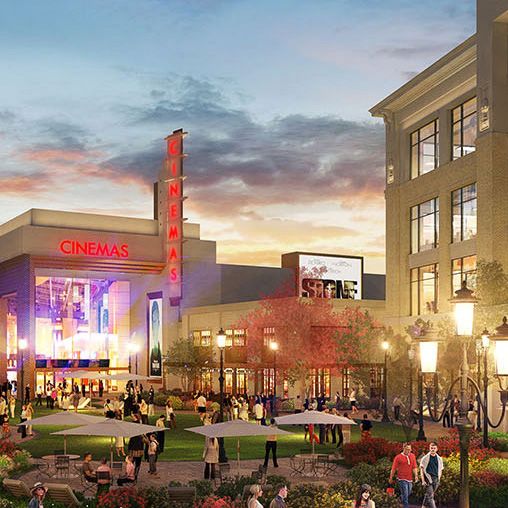
Place-based advertising, defined
Place-based advertising is out-of-home (OOH) advertising that lives inside specific venues rather than along roads. Your message appears on backlit displays, digital screens, banners and wraps in the places people choose to spend time, including shopping malls, lifestyle centers, outlet centers, city centers, offices, restaurants and entertainment venues.
The idea is simple: instead of trying to reach people at home, on their phones or at highway speed, you meet them where they live, eat, work, shop and play. Because the audience is defined by the place, you can choose exactly which communities you reach, down to one shopping center near your business.
You will also hear related terms. Retail media usually means place-based advertising inside or near stores, close to the moment of purchase. DOOH (digital out-of-home) refers to the digital screens used in many place-based networks.
How place-based advertising works
- Pick venues. Choose the centers your customers visit. Universal Media works with malls, lifestyle centers and outlets in selected markets.
- Pick formats and placements. Entrances, anchor stores, escalators and food courts deliver the most frequency.
- Set dates and budget. Universal Media campaigns run for a campaign length agreed with your planner so people see the message repeatedly.
- Supply creative. A printed poster for backlit displays or a static/animated file for digital screens. Designers can help.
- Launch and measure. Watch calls, website visits, searches for your name and store traffic during the campaign.
See the step-by-step version on How It Works.
Common place-based formats
- Static backlit displays: illuminated posters in walkways, entrances and food courts that show only your ad.
- Digital screens and kiosks: 68–84" high-brightness screens and kiosks that rotate static or animated ads and can be updated in real time.
- Digital spectaculars: large-format screens of about 24'7" × 11'5" for maximum impact.
- Sky banners: double-sided banners hung in mall atriums, visible from several directions.
- Elevator, escalator and window wraps: high-dwell surfaces that turn a whole space into your ad.
- In-store retail media: screens in store windows and aisles; see the Retail Media Network.
- EV charging screens: the EV Totem™ reaches drivers while they charge.
Compare them on Formats.
Why businesses use it
It can't be skipped, blocked or scrolled past. Displays in a venue are 100% viewable and brand-safe. There is no ad blocker for a lit display in a food court.
People are in a buying mindset. Shoppers are already out, often within steps of a store. Nielsen research cited on Universal Media's formats page found that 74% of people who visited a store after seeing an OOH ad made a purchase.
It gets noticed and remembered. The same research found 90% of people recall seeing OOH advertising, and mall shoppers, who spend about 3 hours per visit, notice illuminated and digital mall displays at a rate of 78%, according to studies cited on the Advertise Here page.
It drives online action. OAAA and The Harris Poll found in 2024 that 38% of mobile users visited an advertiser's website after seeing a digital out-of-home ad. Nielsen found OOH drives more online activity per ad dollar than TV, radio or print.
Source: OAAA, 2026
When place-based advertising is the right choice
It tends to work best when:
- Your customers live or shop near a specific center. This suits clinics, dealerships, restaurants, gyms, real-estate communities, schools and service businesses.
- You want a real-world presence that reinforces your digital ads.
- You are opening a location, launching a product or running a seasonal promotion in one market.
- You want to reach a whole metro area through several venues at once.
It is less useful if your customers are spread thinly nationwide and only ever buy online. For a candid checklist, read Is mall advertising worth it?
How it compares with other media
Roadside billboards reach drivers for a few seconds; place-based displays reach people on foot, at eye level, often several times in one visit. Online ads can be targeted precisely but are easy to ignore. Most strong campaigns combine all three. See mall ads vs billboards vs digital.
What it costs
Compare venue, format, production and installation costs in our guide to how much mall advertising costs.
Common questions
What is place-based advertising?
Out-of-home advertising shown inside venues such as malls, lifestyle centers, outlets, offices and entertainment venues, where people spend time and are often ready to buy.
Is place-based advertising the same as retail media?
They overlap. Retail media usually means place-based advertising in or near stores, close to the point of purchase. Place-based is the broader term for any venue-based out-of-home media.
What is the difference between OOH and DOOH?
OOH (out-of-home) is any advertising people see outside their homes. DOOH (digital out-of-home) is the digital-screen part of it, where ads can rotate, animate and be updated in real time.
How long does a place-based campaign run?
Universal Media campaigns run for a campaign length agreed with your planner; many advertisers run longer to build repetition.
Where does Universal Media offer place-based advertising?
In malls, lifestyle centers and outlet centers in California, Florida, Iowa, Massachusetts and Utah, with market-level campaigns planned on request in Idaho, Oregon and Texas. See Our Locations.