
Side-by-side comparison
| Mall advertising | Roadside billboards | Online & social ads | |
|---|---|---|---|
| Who sees it | Shoppers on foot in a specific center | Drivers and passengers on a route | People on phones and computers |
| Viewing time | At eye level, often several times per visit | A few seconds at speed | A scroll, if it isn't skipped or blocked |
| Closeness to purchase | Steps from stores and restaurants | Miles from the point of sale | One click away, but easy to ignore |
| Message length | Short headline plus an offer or QR code | A handful of words | Flexible |
| Targeting | By venue and neighbourhood | By road and commute | By interest, demographics and behaviour |
| Can it be blocked? | No. Fully visible | No | Yes: ad blockers, skips and scrolling |
Mall advertising: strengths and trade-offs
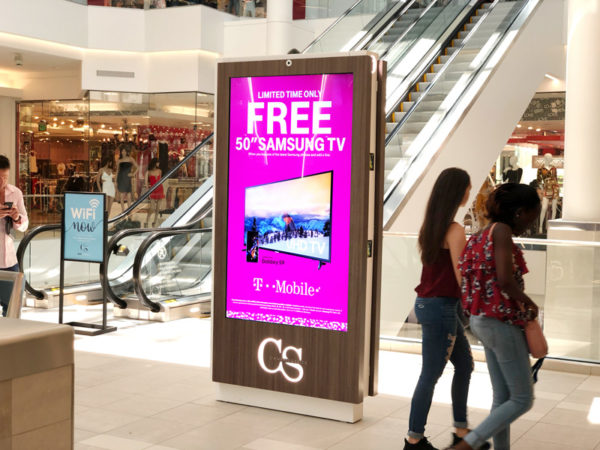
Mall advertising puts your brand on backlit displays, digital screens, banners and wraps inside shopping centers. Shoppers spend about 3 hours per visit, and studies cited on the Advertise Here page found 78% notice illuminated and digital mall displays. Because people walk past the same display more than once, a single placement builds frequency fast.
Best for: local stores and services near a center, product launches, seasonal promotions and any brand that wants to be seen close to a purchase.
Trade-off: reach is limited to the venues you book, so a business with customers spread across a huge area may need several venues, or a mix with other media.
Roadside billboards: strengths and trade-offs
Billboards are built for broad awareness along a commute. Repeated drives past the same board make a name familiar across a whole metro area.
Best for: wide awareness, directional messages (“next exit”) and brands that sell to almost everyone in a region.
Trade-off: drivers see a board for seconds, so messages must be extremely short, and the viewer is usually far from where they would buy.
Online and social ads: strengths and trade-offs
Online ads offer precise targeting and click-level reporting, and you can start and stop quickly.
Best for: retargeting, lead capture and reaching niche audiences by interest.
Trade-off: ads compete with everything else on a screen and can be skipped, blocked or scrolled past. Out-of-home helps here: Nielsen found OOH drives more online activity per ad dollar than TV, radio or print, and OAAA and The Harris Poll found in 2024 that 38% of mobile users visited an advertiser's website after seeing a digital out-of-home ad.
How the costs compare
Each medium prices differently. Online ads are usually bought by clicks or impressions; billboards by the board and period; mall advertising by venue, format, number of displays and campaign length.
Compare the media, production and installation costs for the same audience and dates. Ask a planner for current prices. See the full breakdown in what affects mall advertising cost.
How to choose or combine
- Local store, clinic or service? Start with the mall or lifestyle center nearest your customers. Find a venue.
- Launching across a region? Combine several venues in one market, for example, current venues in Salt Lake City.
- Already running online ads? Add place-based displays so people see you in the real world, then search for you online.
- Want drivers too? EV charging screens reach drivers while they're parked, not passing at speed.
Common questions
Is mall advertising better than billboards?
For reaching shoppers close to a purchase, usually yes: mall displays are seen on foot, at eye level and repeatedly during a visit. Billboards are better for broad awareness along a commute.
Is mall advertising cheaper than billboards?
Compare actual quotes for your audience, formats and dates. Costs vary by location and campaign scope.
Should I stop online ads if I advertise in a mall?
No. They work well together. Out-of-home drives online activity: in a 2024 OAAA and The Harris Poll study, 44% of mobile users searched online for the advertiser after seeing a digital out-of-home ad.
Which is best for a small local business?
Start with one display at the venue closest to your customers for a campaign length agreed with your planner, measure calls, searches and visits, then expand.
Can digital mall screens show video?
Digital screens can show static or animated ads, and large-format spectaculars support full-motion content. Creative can be updated during the campaign.